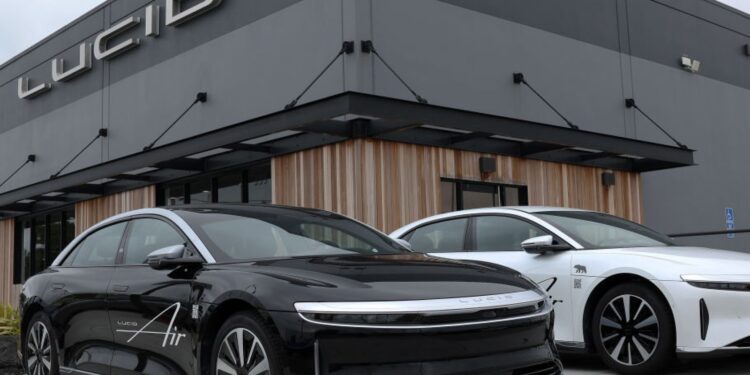
Lucid has opened its first studio in Alkhobar, completing its showroom network across Saudi Arabia’s three largest regions and reinforcing the Kingdom’s shift toward electric mobility under Vision 2030.
The new Eastern Province location targets one of Saudi Arabia’s highest-spending markets and deepens the company’s US-Saudi manufacturing and technology partnership. Interim CEO Marc Winterhoff said the expansion is driven purely by demand, noting that the eastern region is the Kingdom’s third-largest market, according to the report.
Expansion and Production Plans in Saudi Arabia
Saudi Arabia has become one of Lucid’s most important global hubs, serving as both a key buyer and a strategic production base. Winterhoff highlighted that the company is majority funded by the Public Investment Fund, which has supported job growth in the US—where over 90 percent of Lucid’s positions are based, according to the report—while enabling the firm to establish its first international facility in the Kingdom.
Lucid is expanding its plant in King Abdullah Economic City and preparing to hire thousands as it scales up production by the end of next year. The factory is expected to move from simple assembly to full vehicle manufacturing, with a planned capacity of 150,000 units annually, according to the report.
Company leadership says Lucid’s plans closely mirror Vision 2030 goals, especially in sustainability and the creation of a domestic automotive industry. Winterhoff pointed to the emergence of a local automotive cluster, with Lucid among the first major manufacturers to anchor this new sector.
Regionally, Lucid Middle East President Faisal Sultan described the Gulf as entering a new phase of electric-vehicle adoption, driven by consumer openness and supportive government policy. He noted that Saudi demand is now growing faster than in several neighboring GCC markets, according to the report.
The Alkhobar studio is expected to accelerate this trend by bringing the vehicles closer to customers who previously had to travel to Riyadh to make purchases. Sultan said the area’s strong purchasing power and appetite for high-tech luxury vehicles made it a natural fit for the brand.
Charging Infrastructure, Localization, and Talent Development
On charging, Lucid is pursuing both infrastructure development and customer education. Sultan emphasized that Lucid’s cars are designed to reduce range anxiety, citing a range of about 835 to 838 kilometers on a single charge, according to the report—enough for many drivers to travel from Alkhobar to Riyadh and potentially return without recharging.
Every new vehicle now comes with a free home charger and complimentary installation, helping ensure daily driving rarely depletes the battery. In parallel, the company is expanding public charging through partnerships with hotels and offices, with about 50 locations currently available across the country, according to the report.
Localization is another major focus. Sultan stated that Lucid’s workforce in Saudi Arabia is more than 70 percent Saudized, a notable figure for a high-tech company, according to the report. The firm is also investing in an R&D center in Riyadh and building a pipeline of Saudi talent through training programs in the US and collaborations with institutions such as KAUST, NAVA in King Abdullah Economic City, and local technical universities.
With studios now in Riyadh, Jeddah, and Alkhobar, Lucid is positioned at the heart of the Kingdom’s three main economic engines. Company executives stress that Saudi Arabia is not just a sales market, but a central pillar of Lucid’s long-term global strategy and its role in the future of electric mobility.